
 简体中文
简体中文
Dai Bin, the director of the China Tourism Academy, led the organization of data, international and policy teams, and jointly with the Economic Editorial Department of Qiushi Journal, recently established a special research team to conduct in-depth investigations into the current operation of the tourism economy and the construction of a tourism power. The research report titled "Discovering New Economic Vitality through Tourism: A Survey of the 2026 Spring Tourism Market" was published in Qiushi Journal in July 2026. The full text is shared below.
Tourism serves as a barometer of the national economy and a thermometer of social development. Holidays are the best window period for observing the high-quality development of the tourism industry and the construction of a tourism power. From the traditional practice of people returning home for the Spring Festival during holidays, to the recent trend of bringing parents to the city for a "reverse New Year celebration", and to the increasing number of families traveling together for the Spring Festival, tourism has become a common choice for the people during the Spring Festival holiday. In 2026, the first 9-day extended Spring Festival vacation was implemented. How did the travel situation of urban and rural residents go during this holiday, what new changes and characteristics did the tourism market present, what new problems and challenges did the tourism industry face, and how can we accelerate the construction of a tourism power? During the Spring Festival holiday, we traveled to all corners of the country, entered cities and villages, and conducted research and visits.
Full of vitality, the tourism market has achieved a successful start to the year.
The survey shows that during the 9-day Spring Festival holiday in 2026, there were 596 million domestic trips made across the country, with a total spending of 803.483 billion yuan; the rate of rural residents' travel exceeded 20%, and the number of rural residents traveling accounted for 15.8% of the total domestic tourists during the Spring Festival holiday; a total of 4.281 million inbound tourists were received, among which 898,000 were foreign inbound tourists; 4.832 million outbound tourists were made, and the data of major tourism markets all reached record highs. With the growth of residents' income, changes in consumption concepts, and the improvement of transportation infrastructure and public service systems, tourism has increasingly become an indispensable part of people's美好生活. The Spring Festival travel has become an important carrier for rural residents to experience culture and obtain emotional value.
Tourists traveled further, spent more actively, and had a better experience. During the 9-day holiday, domestic tourists' average travel radius was 231.39 kilometers, and their average destination radius was 21.83 kilometers, showing a steady upward trend. Surveys revealed a significant increase in popularity for small and medium-sized cities and county-level central towns during this year's Spring Festival holiday, with 60.2%, 31.9%, and 18.8% of surveyed tourists choosing these destinations respectively. In places like Linquan in Anhui, Hanshou in Hunan, and Lingshan in Guangxi, diversified, personalized, and high-quality tourism products increased significantly, leading to a doubling of local hotel bookings. In Langzhong Ancient City in Sichuan, traditional New Year customs such as dragon dances, spring greetings, and pasting New Year decorations were performed in turn. As night fell, lights outlined the ancient city's eaves and brackets, and young people dressed in Hanfu carried lanterns in groups, their lights winding and flowing along the bluestone streets, making the whole street resemble a flowing galaxy. Another characteristic is the significant increase in tourist activity at their destinations. People are no longer satisfied with simply "having been there" or "having seen it," but seek to "participate" and "immerse themselves." In Chaoshan, Guangdong, tourists follow the Yingge dance troupe into the ancient alleys. As soon as the drumbeats begin, they are no longer just spectators, but dancers, drummers, and members of the parade. In southeastern Guizhou, the village evening stage becomes a stage for tourists to showcase their talents, singing and dancing together as they go from village to village. In Panshan, Tianjin, tourists follow the "Five Immortals" on a mountain tour to receive blessings, sharing the peaceful and prosperous atmosphere of the country through games like pitch-pot and flower-flying games.
The integration of "culture+" and "technology+" has enriched the tourism product system. Surveys show that scenes with a festive atmosphere, a lively ambiance, and a technological feel are more attractive. Traditional festival activities are the most popular among tourists, with a high percentage (63.9%) willing to make a special trip to attend; attending a bustling rural market and exploring the streets and alleys for authentic New Year's snacks are favored by 28.5% and 28.2% of tourists respectively, indicating that culture has become a core element in enhancing tourists' sense of well-being. Tourist attractions, resorts, historical and cultural blocks, and leisure commercial districts ("three zones and one circle"), museums, art galleries, libraries, science and technology museums, and cultural stations ("four halls and one station"), as well as mega-projects and large-scale scientific installations, are all popular new spaces for cultural experiences and new scenarios for tourism consumption. The "Metaverse Spring Festival Temple Fair," launched during the Spring Festival, allowed family and friends in different locations to overcome geographical limitations and share a reunion feast online. AR technology brought the characters in New Year's paintings in museums to life, sending blessings face-to-face. This holiday, robot convenience stores have sprung up in many scenic spots and neighborhoods across the country. These technologically advanced robots autonomously identify, grab, and deliver goods on shelves, becoming a viral sensation on social media and fostering a new tourism ecosystem where the virtual and real worlds coexist and are co-created by the public. Research shows that driven by strong demand, more funds are flowing into the tourism industry, specifically targeting the creation of new spaces and scenarios. This not only enhances the industry's vitality but also promotes its upgrading. In 2025, fixed asset investment in Hainan's tourism and related industries increased by 30.8% year-on-year, reaching 42.6 billion yuan; investment in key cultural and tourism projects in Gansu increased by 17.89% year-on-year, reaching 21.92 billion yuan.

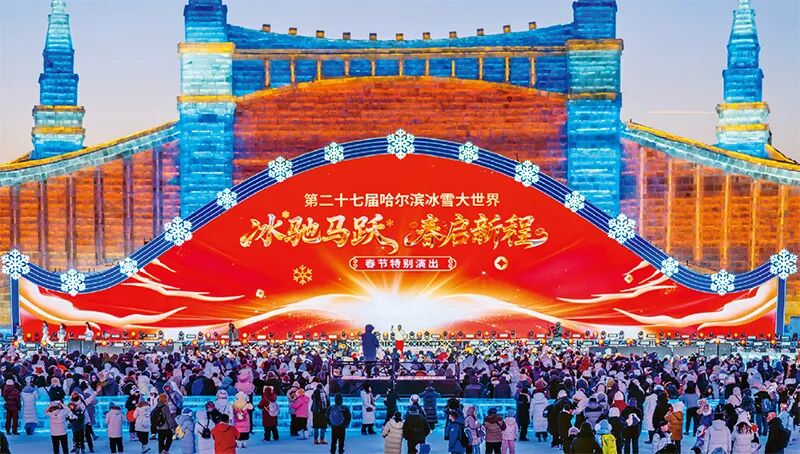
On February 16, 2026, on the eve of the Spring Festival, at the ice and snow world in Harbin, the dazzling and ethereal dream stage was illuminated with brilliant lights, and a series of wonderful performances were staged one after another. Tourists spent the festival joyfully in the icy and snowy landscape.
Photo by Chi Shiyou, released by China News Service
Tourism infrastructure and public services are empowering new business models. Research shows that an increasing number of government compounds and public facilities are proactively opening themselves to tourists. Xiamen, Suzhou, Hengyang, and other cities have opened parking lots in government compounds and provided free roadside parking; Yongzhou in Hunan, Dunhuang in Gansu, and Zitong in Sichuan have opened government canteens and provided convenient meals; Pingtang in Guizhou and Confucius Temple in Nanjing have created a three-dimensional "sky, earth, and man" patrol system, with drone patrols, unmanned vehicle broadcasts, and police officers stationed at designated points. This shift from "closing the door to work" to "removing walls to welcome guests" reflects a profound transformation in government management from passive management to proactive service. When tourists discover that they can even walk into government compounds to rest and ask for directions, and that office buildings can become photo spots, they experience not only peace of mind and convenience, but also the sincerity and warmth of a city. This holiday, while highways offered free passage, satellite navigation, and safety rescue services, more and more scenic routes and new highway tourism scenarios have emerged. Highway service areas such as the Yangcheng Lake section of the Shanghai-Nanjing Expressway in Suzhou and the Fangmaoshan section of the Shanghai-Chengdu Expressway in Changzhou have introduced new designs and business models, becoming popular photo spots for self-driving tourists. A survey shows that the national tourist satisfaction score during this year's Spring Festival holiday reached 81.9 points, an increase of 2.7 points compared to 2025. Among them, tourists aged 60 and above had the highest satisfaction, and rural tourists had a higher satisfaction score than urban tourists, indicating that the improvement of tourism services for the elderly and rural residents has been very effective, and tourists can feel every effort the government has made.
The Spring Festival has become a global cultural event and a hot spot for tourism consumption. Surveys show that tourists from 179 countries visited China during the Spring Festival, with destinations ranging from major cities like Beijing, Shanghai, Guangzhou, Shenzhen, Chengdu, and Chongqing, to famous tourist cities such as Guilin, Datong, Xishuangbanna, Sanya, Huangshan, and Zhangjiajie, as well as relatively niche destinations like Jining, Anqing, and Altay. In Yucun Village, Anji County, Zhejiang Province, domestic and international tourists immersed themselves in rural life, picking fruits and vegetables with villagers, experiencing folk customs, and encountering a dragon lantern parade full of youthful creativity, becoming part of a village that is both ancient and young. This Spring Festival, Yucun deeply integrated traditional New Year activities with the "Global Partner Program," extending a sincere invitation to young people from around the world. Young people from many countries visited the countryside, experiencing not only the rich atmosphere of the Chinese New Year, but also the open, vibrant, and inclusive reality of China against the backdrop of comprehensive rural revitalization. Meanwhile, from the light show at the Burj Khalifa in Dubai to the dragon dance parade on the Champs-Élysées in Paris, and the New Year's Eve red hues of the Empire State Building in New York, world landmarks donned limited-edition Chinese New Year "skins." In São Paulo, Brazil, the 21st annual Happy Chinese New Year Carnival attracted tens of thousands of people, who transformed from "spectators" into "participants" through interactive activities such as calligraphy, acupuncture, and Chinese dance. As the cultural fervor of the Chinese New Year sweeps the globe, more and more foreign friends are truly "becoming Chinese" amidst the festive atmosphere.
The transformation brings new challenges to the tourism industry. This year's bustling Spring Festival tourism market is not merely a simple addition of people and consumption; it also reflects the deep pulse and vigorous vitality of China's social development. Along the way, we have witnessed that the willingness of urban and rural residents to travel has been on the rise, and there are abundant cultural activities and tourism products available in various regions. The tourism market is prosperous and orderly. The convenient transportation network from the Hexi Corridor in Gansu Province to Sanya in Hainan Province has made the "winter escape trip" during the Spring Festival within thousands of kilometers easily accessible. The Beijing Ditan Spring Festival cultural temple fair and Longfu Temple's "Non-stop, Longfu Trendy Market" New Year market have quietly integrated the traditional New Year customs and temple fair atmosphere that have lasted for hundreds of years into modern life. The beauty of nature and culture, from the scenery before our eyes, has internalized into a resonance of the soul. The meaning of travel may lie in this profound experience that transcends mountains and rivers and connects the past and the present.
During our research, we found that as people's consumption concepts undergo continuous transformation, new demands are constantly emerging; as infrastructure becomes more complete, new possibilities are continuously expanded; and as cultural self-awareness and confidence are increasingly infused with new connotations, a profound transformation in the tourism industry from model expansion to content-driven development has already begun. However, many regions still have insufficient understanding and inadequate preparation for this transformation. Tourism development has not yet broken free from the path dependence of tickets and traffic flow, and culture is often narrowly defined as elements that can be transplanted and replicated. This superficial combination of "putting on a cultural show while letting tourism perform" has led to the persistent unresolved problems of traditional development and the successive emergence of new challenges, becoming a deep obstacle hindering the transformation of tourism towards a content-driven development model.
Travel agencies, tourist attractions, and hotels, among other traditional sectors, are facing unprecedented pressure to transform. Research reveals a rapidly evolving market demand for personalized, high-quality, and in-depth experiences, while many traditional suppliers remain confined to outdated models of resource dependence, product homogeneity, and standardized services, resulting in a disconnect between supply and demand. For example, product models are outdated; traditional group tours still predominantly employ a "multi-attraction, short-stay" checklist approach, creating a conflict between the desire for leisurely enjoyment and the pressure to "hurry up," directly impacting tourist satisfaction and repeat visits. Content innovation is insufficient; many tourism projects prioritize infrastructure over content, leading to homogenized characteristic towns, with some tourists complaining that "every scenic spot is doing ironwork, and every ancient town is selling stinky tofu." Operational capabilities are weak; many scenic spots remain stuck in a ticket-based economy mindset, failing to cultivate secondary consumption scenarios, and even exhibiting short-sighted behaviors such as excessively extending internal transportation and bundling services to boost revenue, damaging the tourist experience. Furthermore, industry differentiation is intensifying; our market research on hotels revealed that while standardized chain hotel packages are experiencing sluggish sales, boutique homestays deeply integrated with local culture and uniquely designed are in high demand and short supply. These findings reflect the slow response of traditional businesses, including travel agencies, tourist attractions, and hotels, to niche markets and differentiated demands such as families with children, senior citizens, pet-friendly destinations, and cultural themes. They also demonstrate a lack of understanding of the deeper shift in tourists' focus from material satisfaction to spiritual enrichment. Consequently, their products and services lack depth, and their attractions lack soul, resulting in tourists "coming, seeing, and forgetting" the sights, making it difficult to generate deep resonance and emotional connection.
The structural contradiction of unbalanced regional and urban-rural development in the tourism market is prominent. During the Spring Festival holiday, the distribution of passenger flow showed a significant "top-heavy" pattern: airfares to popular cities such as Hainan surged due to the surge in passenger traffic, while 14.8% of the 337 monitored cities saw a year-on-year decrease in tourist volume, with nearly 80% of these cities located in northern China. The total passenger flow of the top five cities was almost equivalent to the total passenger flow of the bottom 100 cities; in terms of inbound tourism, the number of foreign tourists received by the top 10 cities was even 10 times the total of the bottom 100 cities. This "uneven distribution" was also clearly visible within the same region. For example, Xi'an's Datang Everbright City received over 4.3 million visitors during the Spring Festival holiday, a significant year-on-year increase, and was packed with people; while another scenic spot, also located in the Guanzhong Plain, despite having a complete Ming and Qing dynasty architectural complex and centuries-old folk performances, received fewer than a thousand visitors per day. On one hand, it was "too crowded to get in," and on the other hand, it was "completely deserted." Behind this lies a structural imbalance in tourism development. Popular regions, with their well-developed transportation, established brands, abundant capital, and professional operations, continue to attract tourists and investment, creating a significant siphon effect. Meanwhile, many regions with unique folk customs, precious intangible cultural heritage, and high-quality ecology remain "hidden gems" due to weak infrastructure, lack of operational capabilities, and limited digitalization, making it difficult to transform their resource advantages into development advantages.
The governance challenges facing the tourism industry in the digital age have not yet been adequately addressed. Research reveals a significant gap between traditional management capabilities and the potential of new technologies. During holidays, many traditionally popular scenic spots still experience massive crowds. For example, in some mountainous areas, tourists queue for over 10 hours, often until dawn, yet still struggle to reach the summit, while the descent is equally congested, ultimately leading to mass ticket refunds and on-site conflicts. While superficially a matter of overcrowding, this actually reflects outdated management concepts and methods. Why is the tourism industry still "crowded" in the digital age? Many places still operate under a traditional model that prioritizes attracting visitors over providing quality service, relying on experience and manpower, neglecting visitor experience and system control. Even when intelligent systems are introduced, they often remain superficial, lacking true understanding or intelligence. Some scenic spots have built big data visualization platforms, but the data is visually appealing but not user-friendly; it can present trends but struggles to support decision-making, trapping digital governance in a "big screen display" scenario. The lack of collaborative mechanisms is also a significant contributing factor. Some tourists have reported to us that when booking across regions and platforms, they often face the inconvenience of repeated authentication and system switching, resulting in a "significant sense of service disconnect." There is insufficient coordination between scenic areas and departments such as transportation, public security, emergency response, and meteorology, leading to a lack of information sharing and resource coordination. This results in peak tourist seasons, which could have been addressed in advance, being met with reactive, on-site "firefighting" responses. A deeper contradiction lies in the fact that many places still cling to the inertia of extensive management, failing to integrate good service into the entire process of tourism planning, construction, operation, and management. They haven't shifted their focus from "how many people came" to "how good the experience is," and they haven't ensured that every facility conveys warmth and every encounter leaves a lasting impression on tourists.
Take advantage of the momentum and embark on a new chapter in the construction of a tourism power country.
The essence of tourism is not the geographical crossing, but the spiritual arrival and the search for meaning. When people embark on a journey, they cultivate a sense of patriotism in the magnificent landscapes, touch the roots of civilization by continuing traditions, expand their knowledge and wisdom through broadening their horizons, and enrich their spiritual world through emotional resonance. This is the deepest value of tourism. The "strength" of a tourism power lies not only in having world-class facilities and an efficient service network, but also in cultural immersion and spiritual shaping. Letting tourists experience the beauty of mountains and rivers and understand the profoundness of Chinese civilization during their travels, making tourism an important carrier for cultivating the vigorous and enterprising spirit of the entire nation, this is the ultimate pursuit of a tourism power. Therefore, to build a tourism power, we must always focus on the needs of "people", systematically unleash the comprehensive efficiency of resources, facilities, markets and governance, and strive to promote the coordinated upgrading of facilities services and cultural connotations. We should truly transform our country's unique natural endowments and profound cultural heritage into sustainable development advantages and tangible cultural appeal, and embark on a tourism development path with high-quality development as the background and people's sense of gain and happiness as the goal.
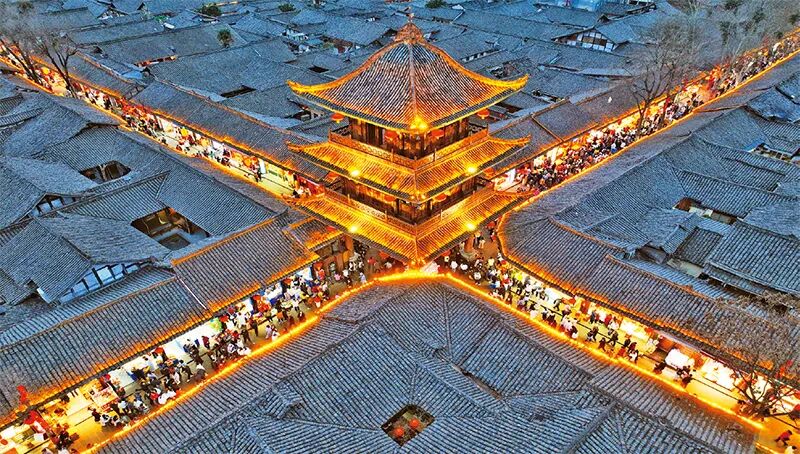
During the Spring Festival holiday in 2026, traditional festival activities were highly popular among tourists.
The picture shows that on February 17, 2026, in the ancient city of Langzhong, Sichuan Province, the night scene was enchanting. The "Langyuan Water Dance" performance at Zhongtian Tower attracted tourists to stop and watch, lost in the charming night.
People's Picture. Photographed by Liang De.
Developing inclusive tourism and protecting the tourism rights of key groups are crucial. Tourism is a vital industry for people's livelihood and well-being, reflecting the characteristics of our times. Public resources such as national parks, scenic spots, classic red tourism sites, and cultural relics protection units are shared by all citizens and serve as important vehicles for promoting traditional culture, strengthening patriotism education, and fostering a nurturing and emotionally enriching lifestyle through tourism; they possess the attributes of public goods. As tourism consumption demands become increasingly segmented, the elderly and children, as well as specific groups, have become significant growth drivers, necessitating the construction of an age-friendly and intergenerational tourism product system. We must further improve the pricing mechanism for state-owned scenic area tickets, guide the reduction of ticket prices for relevant scenic areas, and develop diversified consumption scenarios, promoting the transformation of the cultural tourism industry from a ticket-based economy to a comprehensive consumption-centric industrial chain. We should support age-friendly renovations of scenic areas, resorts, streets, and cultural venues, addressing age restrictions for elderly people traveling by air and in group tours, ensuring worry-free travel for the elderly. We should encourage the development of study tours for youth and build a number of high-quality study tour camps, bases, routes, and courses. We should guide local governments to extend preferential policies to farmers and other groups during the off-season for agriculture and tourism.
To enhance the rule of law and improve the effectiveness of digital governance in the tourism industry, we must address emerging trends such as the spread of unreasonably low-priced tours to online platforms and rural areas, as well as new problems arising from the expanded application of new technologies and changes in cross-border supply chains. We need to accelerate the formulation of the "Regulations on the Management of Tourist Attractions and Resorts," integrating and refining management requirements for various types of tourist attractions and national and provincial-level tourist resorts. We must also expedite the improvement of provisions protecting the interests of independent travelers, tourism investment, and the rights and responsibilities of tourism operators to effectively safeguard tourists' rights. Furthermore, we encourage the use of technologies such as artificial intelligence and semantic analysis to conduct cross-platform monitoring of tourism products and live streams on internet platforms, intelligently identifying low-priced tours and shopping tours, and providing targeted warnings to relevant jurisdictional management departments. We should support qualified regions in accelerating the construction of new infrastructure, and deeply integrate digital governance capabilities into the tourism industry by building an integrated sensing network, optimizing personalized push capabilities, and improving the data governance system. We should also utilize technologies such as multi-layered grid division and big data monitoring of passenger flow to conduct passenger flow forecasting, classified early warning, peak passenger flow diversion, and emergency command for key tourist attractions and venues during peak tourist seasons, so as to promote the upgrading of the cultural and tourism ecosystem from "attracting traffic" to "retaining visitors through experience".
Promoting the deep integration of culture and tourism is crucial for building a new pattern of all-for-one tourism. Culture empowers tourism, and the deep integration of culture and tourism can activate the unique resources hidden in rural areas, ethnic minority regions, and border areas, giving rise to new business formats and scenarios such as cultural heritage, study tours, performing arts, cultural and creative industries, and digital cultural tourism. This not only enhances the intrinsic value and added value of the tourism industry but also allows tourists to experience emotional resonance and spiritual satisfaction. We should learn from the practices and experiences of Xi'an, Suzhou, and other places, leveraging our own cultural endowments to create immersive, experiential, and interactive cultural tourism products. Tourists can not only visit the Terracotta Warriors but also "touch" the grandeur of the Tang Dynasty through diverse forms such as night tours, performing arts, and archaeological study tours; they can not only visit gardens but also "savor" the culture of Jiangnan through "garden-style" Kunqu Opera performances, intangible cultural heritage kesi (silk tapestry) handicrafts, and Suzhou-style lifestyle aesthetics homestays. We must firmly establish the concept of all-for-one tourism. Tourism is a comprehensive industry; it's not just about how exquisite the scenic spots are, but also about the overall environment of the region and the depth of tourist participation and interaction. From information services at airports and high-speed rail stations to the construction of scenic roads along the routes, and even the hygiene standards of rural homestays, the entire region is an extension of the landscape. We must promote the transformation of cultural and tourism spaces from closed attractions to open, multi-functional spaces, supporting eligible areas in converting historical blocks and industrial heritage sites into new, shared spaces for residents and visitors to enjoy a better life, integrating creative shops, design hotels, experimental theaters, themed restaurants, and co-working spaces, achieving new experiences such as "readable architecture, strollable streets, and warm living." We must adapt to the new consumption trends of young people, focusing on new demands such as "traveling to a city for a delicious meal" and "visiting a city for a concert," actively cultivating new "tourism+" content such as music festivals, art seasons, and trendy markets, continuously improving the commercial reception environment, and striving to create tourist destinations with scenery, stories, life, and art.
Promoting the facilitation and internationalization of inbound tourism and guiding outbound tourism towards "reverse flow" is crucial. Tourism showcases not only landscapes and culture to the world, but also a real, multifaceted, and developing contemporary China. While visa-free policies have been frequently introduced in recent years, soft barriers such as "difficulty in checking in" and "cumbersome reservations" remain real obstacles for overseas tourists visiting China, preventing the policy benefits from translating into actual tourist traffic. We need to build a convenient living circle that aligns with international standards and is shared by both locals and tourists, making inbound tourism not only convenient but also upgrading it from a superficial sightseeing experience to a deeper experiential one. We should guide the development of popular consumer items such as Shenzhen's Huaqiangbei smart equipment, Yiwu's creative trendy products, and Hainan's duty-free goods, transforming single-item shopping into a full-chain consumption experience. Leveraging national parks, national cultural parks, and mega-projects, we should cultivate high-quality routes showcasing contemporary China's technological strength and ecological philosophy, using tourism as a flexible medium to tell the vivid story of China's modernization. Furthermore, while the current outbound tourism market is enormous, it has not yet been effectively converted into a "reverse flow" channel for inbound tourism, resulting in information asymmetry and service disconnect between domestic and international tourism markets. We must leverage the power of travel agencies and online travel platforms to integrate inbound tourism promotion while organizing outbound tours, ensuring that outbound travelers bring back a genuine desire to "travel to China" and "shop in China." The global appeal of a tourism powerhouse ultimately lies in providing global tourists with not just scenic encounters and cultural experiences, but also a credible, approachable, and resonant value experience. This experience embodies the wisdom of development, cultural confidence, and reflects contemporary China's composure towards the future and its open-mindedness in embracing the world.
Author | Guo Firan, Dai Bin Editor-in-Chief | Liu Xin Source | Qi Shi Network Reproduction must indicate the author and the source.


ALL RIGHTS RESERVED:CHINA TOURISM ACADEMY (Data Center ofthe Ministry ofCulture and Tourism)
ICP备案: 京ICP备2021001490号-1


