
 简体中文
简体中文
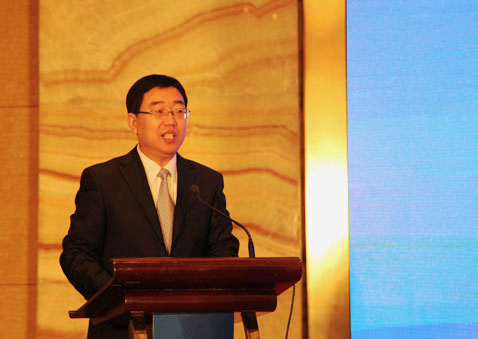
Sohu Travel Channel special report link: http://travel.sohu.com/s2014/2014-ctas/index.shtml?qq -With strong support from all sectors of society, the 2014 China Tourism Science Annual Conference was held on April 19-20, 2014 at the Tangla Yaxiu Hotel in Beijing. Du Jiang, Deputy Director of the National Tourism Administration, attended the annual meeting and delivered a speech. The theme of this year's conference is "The Formation and Development of Academic Thought", hosted by the China Tourism Research Institute, co organized by Ctrip Travel Network and Hainan Airlines Travel Industry, and supported by Sohu Tourism Channel. Du Jiang said in his speech that the theme of this year's conference is "The Formation and Development of Academic Thought", which is very meaningful from both the current requirements of tourism industry practice and the development trend of academic research. China's tourism economy has developed to today and has formed the world's largest domestic and outbound tourism market, with inbound tourism also ranking among the top in the world. Currently, China is closely focusing on the two strategic goals of tourism development, deepening reform and opening up, accelerating the transformation of development mode, and striving to build an upgraded version of China's tourism economy. The prosperity and transformation of the tourism industry practice have put forward practical requirements for the innovation of tourism theory and the growth of academic thinking. Over the past thirty years, tourism research has accumulated a large amount of literature, information, data, and case studies on the development of local governments and enterprises. According to authoritative data from China National Knowledge Infrastructure, there are over 25000 academic papers on tourism topics per year. Although there are a large number of academic achievements in tourism, there is still room for further improvement in terms of quality. For example, there are not many original academic achievements published in high-level and internationally authoritative journals, and theoretical accumulation is relatively limited, especially in the areas of scientific discovery, knowledge solidification, and practical guidance where there are few excellent works. Du Jiang stated that the formation of academic ideas in tourism requires national tourism researchers and educators to have higher theoretical confidence, stand at the forefront of world tourism science more consciously, and integrate more consciously into the strategic deployment of the Party and the state on the prosperity and development of philosophy and social sciences. It is necessary to solve both basic theoretical problems such as "what tourism is" and development theoretical problems such as "why tourism development is", "what to rely on", and "what to do"; We should not only pursue the logical consistency required for scientific research, but also strive to solve several major practical problems in tourism development practice. The formation of academic ideas in tourism requires joint efforts from the national tourism theoretical community and further strengthening the integration of theory and practice. I hope that scholars can not only understand the laws of nature, but also be more down-to-earth, scientifically analyze national conditions and travel situations, condense tourism academic ideas with Chinese characteristics, and serve the development of the industry to the greatest extent possible. More than 200 officials from relevant departments and directly affiliated units of the National Tourism Administration, representatives of co organizers of the annual conference, media representatives, and experts and scholars from the tourism industry across the country attended the conference. Yang Jianhong, Vice Chairman and CEO of HNA Tourism, and Guo Dongjie, Senior Vice President of Ctrip, delivered speeches at the annual meeting. Zhou Jiucai, Deputy Director of the Policy and Regulations Department of the National Tourism Administration, announced on behalf of the National Tourism Administration the list of research projects approved by the National Tourism Administration in 2014 and the list of outstanding academic achievement awards in 2013, and presented the awards. Feng Xiang, the representative of the National Tourism Administration's Outstanding Academic Achievement Award in 2013 and an associate professor at Shanghai Normal University, delivered his acceptance speech. The keynote speech segment on the morning of the 19th was hosted by Song Ziqian, Director of the Policy Institute of China Tourism Research Institute. Ma Bo, Academic Member of China Tourism Research Institute and Dean of the School of Tourism at Qingdao University, Lu Lin, Professor of Anhui Normal University, Gu Huimin, Dean of the School of Hotel Management at Beijing International Studies University, and Guo Lufang, Professor of Zhejiang Technology and Business University, respectively gave keynote speeches on the themes of "Enriching Chinese Tourism Academic Thought through Dual Interaction of Four Sources and Flow", "Reflections on Chinese Tourism Research", "Research on Academic Influence of Chinese Hotel Management Scholars", and "Leisure: Returning to the Original Aspiration of Life". Zhang Dong, Vice President of China Tourism Research Institute, presided over three sub forums of the afternoon conference. The attending tourism experts and industry representatives conducted in-depth and detailed round table discussions on issues such as "innovation and theoretical construction of business models in the era of mobile travel", "cultivation of new tourism ecosystems and formation of industrial ideas", and "regional tourism innovation practices and national tourism development ideas". On the morning of the 20th, the Academic Thought Research Forum was chaired by Vice Dean Zhang Dong, and was divided into three parallel forums: "Academic Research and Practice Interaction from an International Perspective", "Qualitative Research and Quantitative Research Methods", and "Cultivation of Theoretical Abstraction Power". Jiang Yiyi, Director of the International Institute of China Tourism Research Institute, presided over the sub forum on "Academic Research and Practice Interaction from an International Perspective". Professor Huang Ailian from Guangxi University, Associate Professor Chen Ye from the School of Tourism and Service at Nankai University, Director and Associate Professor Xie Ting from the Department of Tourism at Beijing Institute of Petrochemical Technology, Associate Professor Liu Jun from Chongqing Normal University, and Associate Professor Feng Xiang from Shanghai Normal University respectively conducted research on "21st Century Maritime Silk Road Tourism Cooperation and Beibu Gulf Response Strategies", "Practical Orientation of Tourism Destination Research", "Sampling Methods of Tourist Surveys and Their Expression in Academic Papers", "Impact of Climate Change on Tourism Vegetation Landscape - Phenological Perspective", and "International Expert", Local Practice: The Operation of China's Urban Tourism Internationalization Project Since 2011 "was the topic of the speech. Professor Li Tianyuan from the School of Tourism and Service at Nankai University, Professor Zhang Heqing, Dean of the School of Tourism at Guangzhou University, and Associate Professor Li Zhifei, Deputy Director of the Department of Tourism at Hubei University, provided comments and engaged in in-depth discussions with the speakers. Tang Xiaoyun, Head of the National Tourism Economy Laboratory at the China Tourism Research Institute, presided over a sub forum on" Qualitative and Quantitative Research Methods ". Associate Professor Cao Guoxin from the School of Tourism and Urban Management at Jiangxi University of Finance and Economics, Associate Professor Ye Xinliang from the School of Management at Shanghai University of Engineering and Technology, and Associate Professor Zhou Yunyu from the School of Tourism Management at Jishou University respectively discussed the value of" Two Points and One Box "- A Brief Introduction to Tourism Research. Research on Service Reception Standards for Shanghai Wusongkou International Cruise Homeport Lecturer Qiu Hongliang from Zhejiang Tourism Vocational College, Lecturer Liu Suheng from Wuhan Changjiang Business School, Associate Professor Wang Jingwu from Beijing Technology and Business University School of Business, Professor Xu Jufeng from Beijing Union University School of Tourism, and Associate Professor Zhang Yanqing from Qingdao University School of Tourism respectively gave speeches on the topics of "The Influence of Tourism Destination Imagery on Local Attachment and Tourists' Intention to Revisit", "Original Thoughts on Tourism Basic Theory Research", "Inquiry and Reflection on the Prerequisite of Tourism World", "Analysis of Tourism Resources and Tourism Attraction: Meaning, Relationship and Applicability", and "Analysis of International Cruise Tourism Industry Organization Based on SCP Paradigm". Wu Qiaohong, Deputy Editor in Chief of Tourism Journal, and Song Rui, Director of the Tourism Research Center of the Chinese Academy of Social Sciences, respectively provided comments. Associate Researcher Yang Jinsong from the International Institute, Dr. Chen Xu from the laboratory, and Dr. Han Yuanjun from the Policy Institute respectively delivered concluding speeches on behalf of the three forums mentioned above. Subsequently, Dai Bin, the President of China Tourism Research Institute, presented the Outstanding Paper Award to the award-winning guests of the 2014 China Tourism Science Annual Conference. Finally, Dean Dai Bin made a concluding speech for the annual meeting, pointing out that the issue of academic ideas raised at this year's meeting, following the construction of disciplines, academic achievements, social services, and professional capabilities, is aimed at discussing with experts and scholars, especially young scholars, the confusion and perplexity they are currently facing and will continue to face in their academic careers. Just like the question of why in academia, tourism cannot escape the question of why tourism development occurs. The most important way to solve these problems is to listen and have dialogue. He said that first of all, we need to learn to listen to the voices of the government and industry. In the process of listening, theoretical abstraction is formed through dialogue, which evolves into academic achievements and then forms academic ideas. This is a form of faith. When we have faith, we can constantly resist this confusion. He believes that the development concept of tourism in the new era should be to achieve more national participation and higher quality sharing, and to strive for the realization of citizens' tourism rights. Our goal is to build a contemporary tourism development system in about ten to fifteen years, to answer why we need to develop tourism, what we rely on to develop tourism, and what we need to do to develop tourism. This new era of contemporary tourism development system aims to spread tourism ideas. Serve, walk alongside, and lead the development of listening through dialogue. Once a thought becomes enlightened, it will transform into a belief. In the process of development, it is also possible to have dialogues with international peers on research methods and theoretical achievements. He emphasized that building faith through ideas is just solving a problem, and it is impossible to expect to construct an academic idea through a conference. In the future, confusion will continue to accompany us on the path of academic growth. What can resist confusion is to form academic ideas for tourism and engage in dialogue with industry, government, and international peers.


ALL RIGHTS RESERVED:CHINA TOURISM ACADEMY (Data Center ofthe Ministry ofCulture and Tourism)
ICP备案: 京ICP备2021001490号-1


